
Michell Instruments
Dew-Point Transmitters – Continuous Moisture Monitoring in Gas Processes
In many industrial gas systems, even small amounts of moisture can lead to corrosion, contamination, or operational problems. Dew-point transmitters from Michell Instruments provide reliable, continuous monitoring of moisture levels in gases, helping you maintain safe and stable process conditions.
Designed for demanding industrial environments, these transmitters deliver accurate dew-point and moisture measurements across a wide range of applications, from compressed air systems to natural gas processing.
Want to know more about our solutions from Michell Instruments?
Reliable sensor technology for precise moisture measurement
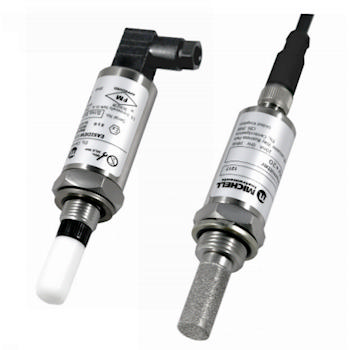
Michell dew-point transmitters use advanced ceramic metal-oxide moisture sensors to measure trace moisture in gases. The sensor technology provides high sensitivity and long-term stability, enabling reliable measurement of extremely low moisture levels.
These transmitters are designed for continuous process monitoring, providing real-time data that can be integrated directly into control systems. With robust industrial construction and flexible installation options, they can be installed directly in pipelines, sampling systems, or process equipment.
The result is dependable moisture monitoring that helps protect equipment, ensure product quality, and maintain process efficiency.
How dew-point measurement helps you control moisture in gas systems
Dew point is the temperature at which water vapor in a gas begins to condense into liquid. By measuring this temperature, you can determine how much moisture is present in the gas stream and whether condensation may occur under process conditions.
Dew-point transmitters measure the moisture content by detecting how water molecules interact with a sensitive sensor surface. In Michell transmitters, a ceramic metal-oxide moisture sensor responds to changes in humidity in the gas. The sensor signal is then converted into a dew-point temperature value that can be transmitted to your control system.
Monitoring dew point continuously allows you to detect moisture ingress early and maintain safe operating conditions. This is especially important in systems where water contamination can cause corrosion, freezing, or reduced product quality.
Typical examples where dew-point monitoring is critical include:
- Natural gas pipelines, where moisture must be kept below condensation levels
- Compressed air systems, where water can damage equipment and tools
- Hydrogen and industrial gas processes, where gas purity is essential
- Drying and purification systems, where moisture removal must be verified
By measuring dew point directly in the gas stream, you gain a reliable indicator of moisture levels and can ensure that your process remains within safe and efficient operating limits.
Key features for industrial gas monitoring
- Continuous dew-point measurement for online process monitoring
- Trace moisture detection down to very low dew-point levels
- Stable ceramic sensor technology with long-term reliability
- Wide measurement ranges suitable for dry and humid gas streams
- Analog and digital outputs for integration with PLC and SCADA systems
- Compact and robust designs for industrial environments
- Fast response times for real-time process control
- Low maintenance requirements
Typical applications for dew-point transmitters
Dew-point transmitters are used wherever moisture levels in gases must be monitored and controlled.
Common applications include:
- Natural gas production and pipeline monitoring
- Compressed air and industrial gas systems
- Hydrogen production and processing
- Petrochemical and refinery operations
- Drying processes and gas purification systems
- Semiconductor and electronics manufacturing
Accurate moisture monitoring helps prevent condensation, corrosion, and contamination in these critical processes.
Benefits for your operation
By implementing continuous dew-point monitoring, you gain better control over your gas processes.
You benefit from:
- Improved process reliability through early detection of moisture ingress
- Protection of equipment and pipelines from corrosion and condensation
- Stable product quality in moisture-sensitive processes
- Reduced maintenance and downtime
- Reliable long-term measurements with minimal sensor drift
These products are used within these applications
Semiconductors
Ensure ultra-high purity and stable semiconductor processes with reliable gas analysis and moisture monitoring from Norsk Analyse.

Petrochemical
Monitor complex gas streams with precision to safeguard processes, personnel, and production quality.

LNG & Natural Gas
Ensure safe, compliant, and efficient gas operations with reliable LNG and natural gas analysis solutions from Norsk Analyse.

Industrial Gases
Ensure gas purity, safety, and process control with reliable industrial gas analysis solutions from Norsk Analyse.