
SWAN
AMI Line-TOC – Continuous Monitoring of Total Organic Carbon in High-Purity Water
In pharmaceutical production and other high-purity water systems, even very small amounts of organic contamination can affect product quality and regulatory compliance.
The SWAN AMI Line-TOC analyzer provides continuous online monitoring of Total Organic Carbon (TOC) in purified water systems. This allows operators to detect contamination early and maintain full control of water quality in critical production environments.
Designed for reliable operation in ultrapure water loops, the analyzer supports real-time monitoring of pharmaceutical water systems such as Purified Water (PW) and Water for Injection (WFI).
Want to know more about our solutions from SWAN?
Direct UV oxidation ensures reliable TOC monitoring
The AMI Line-TOC measures TOC using direct UV oxidation combined with conductivity detection.
During the measurement process:
- The water sample enters the analyzer’s UV reactor
- UV radiation oxidizes organic carbon compounds
- The oxidation process converts organic carbon into carbon dioxide (CO₂)
- The analyzer measures the resulting conductivity change to determine the TOC concentration
This measurement principle is particularly well suited for very low TOC concentrations found in ultrapure and pharmaceutical water systems.
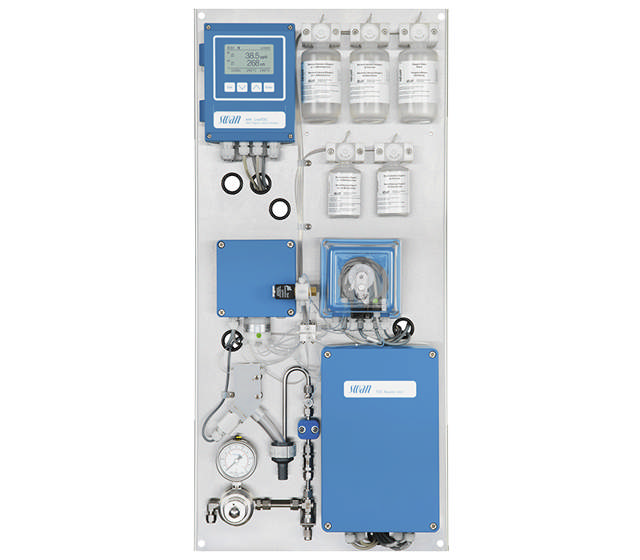
See how the AMI Line-TOC measurement principle works
The illustration below shows how direct UV oxidation and conductivity detection are combined to measure TOC continuously in high-purity water systems.
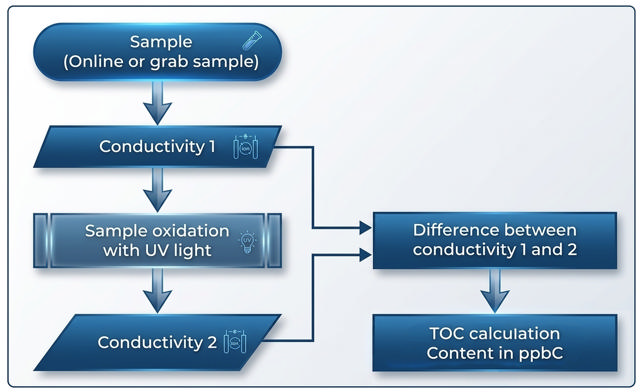
The AMI Line-TOC oxidizes organic carbon using UV radiation. The resulting CO₂ changes the conductivity of the sample, allowing accurate TOC determination in high-purity water systems.
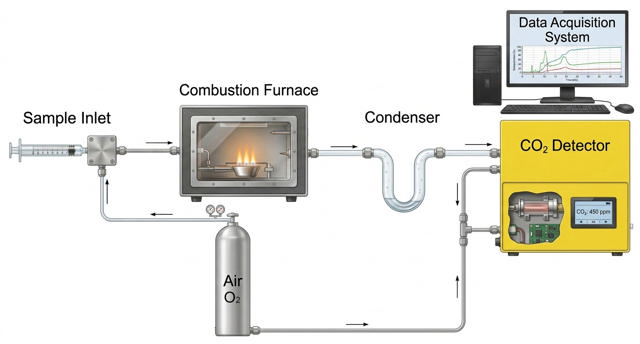
Thermal oxidation
With this method (Figure 1), the organic components are broken down at high temperatures. The undissolved content is completely oxidized (suspended solids and particles). This method is reliable, especially with high organic load (e.g. water from municipal sewage treatment plants).
Figure 1
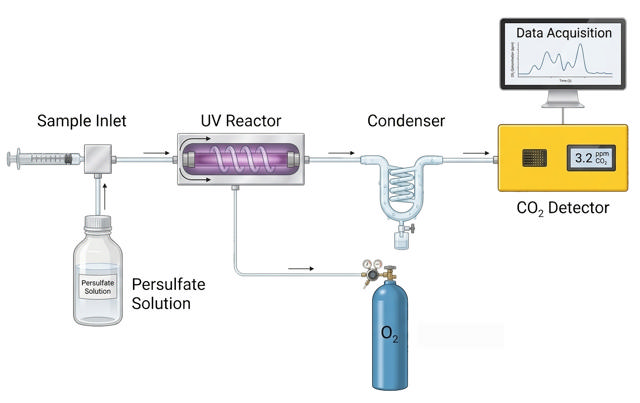
UV Persulfate Oxidation with NDIR Detection/Conductivity Detection
Wet chemical oxidation with persulfate and UV light is a widely used method (Figure 2), especially for pure and ultrapure water. A major advantage of this method is the large measurement range (from less than 1 ppb to over 100 ppb) and the high precision. However, high purity chemicals and purge gas are required, which are major cost factors.
Figure 2
Key features supporting stable TOC monitoring
- Continuous online measurement of Total Organic Carbon (TOC)
- Direct UV oxidation measurement technology
- High sensitivity suitable for ultrapure and pharmaceutical water systems
- No need for continuous addition of costly chemical reagents
- Real-time monitoring for rapid contamination detection
- Compact analyzer design suitable for installation in water loops
- Industrial communication interfaces for automation systems
These features help ensure continuous verification of water purity in critical production environments.
Applications in pharmaceutical and high-purity water systems
The AMI Line-TOC analyzer is used in industries where water purity must be continuously verified.
Typical applications include:
- Pharmaceutical purified water (PW) systems
- Water for Injection (WFI) monitoring
- Pharmaceutical production water loops
- Biotechnology and life sciences facilities
- Semiconductor ultrapure water systems
Continuous monitoring helps ensure that water systems remain within regulatory limits and free from organic contamination.
Benefits for your operation
With continuous TOC monitoring you gain:
- Early detection of organic contamination
- Continuous verification of water purity
- Reliable monitoring of pharmaceutical water systems
- Reduced risk of product contamination
- Improved compliance with regulatory requirements
These benefits support safe and stable operation of high-purity water systems.
These products are used within these applications

Swimming Pools
Ensure safe and compliant pool operation with reliable monitoring of chlorine, ozone, turbidity, and water quality. Get insight into the right measurement approach.

Pharmaceuticals
Reliable monitoring solutions for life science environments – including purified water analysis, gas monitoring and medical gas verification.

Food and Beverages
Ensure stable production and consistent product quality with reliable monitoring solutions for food and beverage processes.