
SWAN
Silica Analyzer – Continuous Monitoring of Silica in Steam-Water Cycles
In power plants and high-purity water systems, even small amounts of silica can cause serious operational problems.
Online silica analyzers continuously measure dissolved silica in water and steam cycles, helping you detect contamination early and protect turbines and boilers from deposits.
With reliable silica monitoring, you can maintain stable water chemistry and long-term equipment performance.
Want to know more about our solutions from SWAN?
Precise photometric measurement for trace silica detection
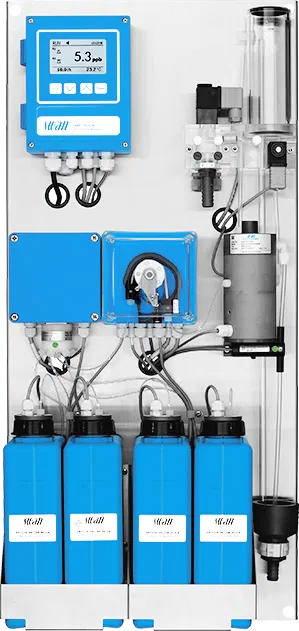
Silica analyzers use colorimetric photometric measurement to determine the concentration of dissolved silica in water samples.
In this process, the analyzer automatically adds reagents to the sample. Silica reacts with the reagent to form a colored compound, and the analyzer measures the resulting color intensity using a photometer.
The system continuously performs:
- automatic reagent dosing
- controlled reaction timing
- optical measurement
- automatic calibration and diagnostics
This allows accurate measurement of silica concentrations down to very low ppb levels, which is essential in modern power plant water chemistry control.
Why reactive silica matters
In steam-water cycles, reactive silica can volatilize with steam and later deposit on turbine blades as silica scale. Continuous monitoring therefore allows operators to detect contamination early and maintain safe silica limits.
Why silica monitoring matters for turbine protection
If silica enters the steam system, it can evaporate with the steam and later deposit on turbine blades as hard silica scale.
These deposits can lead to:
- reduced turbine efficiency
- imbalance and mechanical stress
- costly cleaning and maintenance
- reduced equipment lifetime
Continuous silica monitoring allows you to detect rising silica levels early and take corrective action before deposits form.
Part of a Steam & Water Analysis System (SWAS)
This analyzer is commonly used in Steam & Water Analysis Systems (SWAS) for monitoring water chemistry in power plant steam-water cycles. These systems provide continuous monitoring of critical parameters to protect boilers, turbines, and condensate systems.
Key features supporting reliable silica monitoring
- Continuous online measurement of dissolved silica
- High sensitivity detection for trace contamination
- Automatic reagent dosing and measurement cycles
- Stable photometric measurement technology
- Integrated diagnostics and alarms
- Industrial communication interfaces for control systems
- Designed for continuous operation in power plants
These features ensure that operators receive reliable real-time information about silica levels in the water-steam cycle.
Typical monitoring points in power plants
Silica analyzers are typically installed at several locations throughout the steam-water cycle.
Common monitoring points include:
- Boiler feedwater
- Condensate systems
- Boiler drum water
- Steam purity monitoring
- Demineralized water systems
Monitoring these points allows operators to identify contamination early and maintain proper chemical balance.
Benefits for your plant operation
With a reliable silica analyzer you gain:
- Early detection of contamination in the water cycle
- Improved protection of turbines and boilers
- Continuous data for water chemistry control
- Reduced risk of scaling and deposits
- Improved operational stability
These benefits support safe and efficient operation of power generation facilities.
These products are used within these applications

Power & Energy
Maintain emissions control, combustion efficiency, and regulatory reporting across power generation and energy production.