
Customer Case
Rotronic helps preserve Danish history
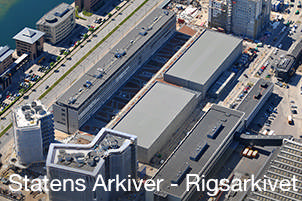
When the Danish National Archives, home to over 800 years of historical documents, began outgrowing its scattered and aging facilities, the Danish State Archives decided to build a new, future-proof archive on the former railway yard at Kalvebod Brygge in central Copenhagen.
The archive stores vital documents from Danish police departments, churches, counties, and municipalities, which are legally required to submit records of historical value. Private individuals have also contributed materials to the archive over the years.
Since the 18th century, the annual volume of materials has grown significantly—although most new records today are digital. The paper-based archive spans two locations in Copenhagen, with the newest facility at Kalvebod Brygge now holding the majority of the 2.6 million boxes containing physical documents.
The Danish National Archives safeguard invaluable and irreplaceable materials from the country’s history—documents that must be protected under the strictest environmental conditions.
👉 Project Facts
Customer:
Danish National Archives, Kalvebod Brygge (constructed 2007–2008)
Partners:
- Kemp & Lauritzen A/S – responsible for operations and maintenance
- Grue+Hornstrup – PLC programming
Archive by the Numbers:
- 20,000 m² of storage space
- 370 kilometers of shelving
- 250,000 custom-designed archive containers
- Oldest documents date back to the 12th century
370 Kilometers of Shelving
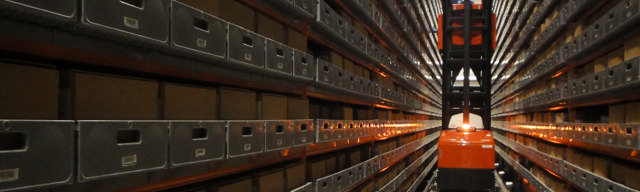
Entering one of the four main archive halls in the new Kalvebod Brygge facility, opened in 2008, visitors are met with an impressive sight: towering shelving units stretching down long corridors.
The facility spans 20,000 square meters and is divided into fire zones. Each shelf unit stands 12 meters high and features 36 shelves—altogether providing 370 kilometers of shelving space.
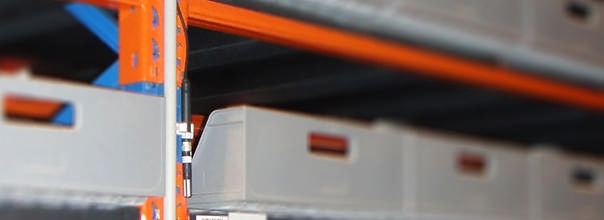
These shelves hold 250,000 specially designed plastic containers, each storing eight document boxes. The shelves themselves, weighing 300 tons apiece, are motor-controlled and move sideways to allow access to one aisle at a time.
In addition to the four main halls, the facility includes eight smaller storage areas—some of which are high-security zones only accessible to authorized personnel.
👉 Environmental Requirements
- Temperature: 14–18 °C (maximum daily variation: ±1 °C)
- Humidity: 30–50% relative humidity (maximum daily variation: ±2%)
Protecting Irreplaceable National Treasures
With ceiling heights reaching 15 meters, maintaining a stable and consistent climate throughout the storage areas is a major technical challenge. The temperature must remain between 14 °C and 18 °C, and the relative humidity must stay within 30–50%.
"The daily variation must not exceed 1 °C and 2% relative humidity. These are strict requirements when you consider the size of the warehouses. The larger a warehouse, the more difficult it is to create a homogeneous environment in terms of humidity and temperature," says Bjarne Nilsson, operations assistant at Kemp & Lauritzen.
"You can have challenges, especially at high altitudes, when the heat rises. The summer period is most critical, as the warm air from outside contains a lot of water. When the air is sucked in, it cools down and therefore needs to be dehumidified further. Humidity and temperature are measured at heights of 2, 7 and 12 meters."
Creating a Homogeneous Environment
Humidity and temperature are monitored using 162 standard Rotronic HC2-S sensors. Communication between the probes and the PLC (Programmable Logic Controller) is handled via Modbus.
Each sensor is connected via a simple cable that amplifies the Modbus signal—no transmitters are used. This results in a fully digital signal path from sensor to control system. The solution is compact, cost-effective, and provides precise measurement. Without analog signals, there's no drift or need for manual calibration, saving both time and effort.
If environmental thresholds are exceeded, automated SMS alerts are sent to on-call staff for immediate intervention.
The archive climate is managed using a full system: humidification by Anderberg, dehumidification by Munters, and an industrial-grade CTS solution (PLC-based control) from Grue+Hornstrup.
Preserving History for the Future
The Danish State Archives expects the new facility to provide sufficient capacity through to at least 2030. By that time, the vast majority of archived content will have transitioned to digital formats.